A Wilderness Science and Art Collaboration

Aldo & Leonardo, a partnership between Colorado Art Ranch and the Aldo Leopold Wilderness Research Institute, is a project to celebrate the 50th anniversary of the Wilderness Act. The project is inspired by the scientific wisdom of Aldo Leopold and the artistic genius of Leonardo da Vinci. Our endeavor is an interdisciplinary collaboration of artists and scientists designed to celebrate the lands, resources and opportunities protected by the Wilderness Act. In 2013, we are hosting one-month residencies in six diverse wilderness areas. Artists will work alongside wildland research scientists and gain firsthand knowledge of the wonders, complexities and challenges of our nation's wildest places. The result will be a body of work that creatively illustrates the value of wild areas and honors the scientific efforts to preserve wilderness for the next fifty years.

Sunday, January 26, 2014

McDiarmid Aldo & Leonardo project @ Kennedy Museum


Wall Text:

you can find images from exhibit  at:

http://woub.org/2014/01/19/photos-ou-school-art-design-faculty-exhibition

 scroll down to find the Kotwa Headress worn  by viewers as a means to experience space & terrain

Artist Statement Duane McDiarmid exhibition Kennedy Museum of Art Athens Ohio
In 2013 The Colorado Arts Ranch in partnership with the Aldo Leopold Wilderness Research Institute, selected 24 artists to commemorate the 50th anniversary of the U.S. Wilderness Act Sending these artists to work in situ with scientists and wilderness rangers in six different wilderness biomes across the United States and its Territories. 
I was selected as one of these Aldo & Leonardo Fellows and traveled to the 907 square miles that is The John Muir Wilderness Area. Located in the alpine biome of the Sierra Mountains, the John Muir sits within the 2,974 sq mile Inyo National Forest and is adjacent to the 721 sq miles that make up the Sequoia and Kings Canyon National Park. It is a remote and isolated place and for 30 days my mandate was to create my work while also working with wilderness rangers on the move in the field. I spent 16 days on foot within the wilderness traversing well over 100 miles and climbing and descending between 1000 and 4000 ft daily. I spent the other 14 days at the National Forest service’s Jack Ass Lake Cabin which served as studio, orientation center, and the base for Aldo Leonardo operations—located near the John Muir wilderness boundary and some 2hrs by car to the nearest cell phone reception, store, phone line, mail service or access to the electrical grid—the cabin was equipped with a propane refrigerator and generator that provided evening electricity.
The ‘Wilderness Act’ mandates the preservation of the ‘Wilderness Character’ of lands, and among its provisions is the prohibition of the development of roads, the building of structures, the extraction or altering of resources and the use of mechanized transport. Much of this can be implemented interpretively—but it is worth noting that I was inspired by Wilderness Manager Adam Barnett who suggested that an interpretation when discussing finding a campsite-- campsites are found not made...if you need to move pine cones or stones perhaps you are making rather then finding camp.  In light of these restrictions my response was to create an embodiment of wilderness character as described by federal legislation and in the spirit there-of I entered and encountered the Wilderness. 
Embedded with Wilderness Rangers I accompanied them on their official duties and roamed on extensive off trail solo excursions--Along the way I employed a series of props that like myself were both in and interruptions to wilderness. On foot in the Sierras I like others performed myself in reaction to wilderness while seeking a communion with it--and I like many sought an adventure with the environment that would be transformative. This came to include sharing the wilderness with a 19,000 acre forest fire which at lower elevations 7000-9000 ft. snowed ash and reduced visibility to well under 100 yards, My climb off trail to glacial fragments along the ridgeline above the Piute Plateau, and many other off trail excursions where I employed props and actions for others visitors or in their absence.
The Document presented here seeks to elude to a multifaceted experience, marked by a profound physical activity and space, and inclusive of a schism deriving from being both rejoined and forever alien to wilderness, all residing within metaphysical experience. 
To experience this document you may wish to swing the Chime-Can and wear the Kotwa Banner. To do so, free the Chime Can’s blue cord from the tripod hook, shift the Banner’s carabineer from tripod strut to your own belt or belt loop. Dangle the Chime Can from the cord 4—12 inches above ground features, and gently and without self consciousness swing the can back and forth while negotiating the ‘local terrain’. You may also wish to dress yourself in the headdress and loincloth. 
Transpiring within physical space and inseparable from material environment the mark is not made upon material—Through process and event, physical force and dream I allow the wilderness to sculpt and reveal I.
On the Aldo & Leonardo Project blog you'll find profiles and interviews with artists and scientists and samplings of their experiences and contemplations. My own entries here are drafted under the author name abracadabra. You are encouraged to supplement your viewing of the documentation here with learning more about the related art and thoughts of Aldo and Leonardo Fellows and to learn of my other actions in the John Muir Wilderness Area, that collectively make up the Kotwa Project.
Excerpts from the Wilderness Act:
Assuring that expanding settlement and mechanization does not occupy and modify all areas within the United States, Congress will secure for the American people and future generations the benefits of an enduring resource of wilderness.
Wilderness Areas shall be administered for the use and enjoyment of the American people in such a manner as will leave them unimpaired for the future use and enjoyment as Wilderness and the preservation of their Wilderness character and for the gathering and dissemination of information regarding their use and enjoyment as Wilderness.
A Wilderness in contrast to those areas where Man and his works dominate is recognized as an area where the earth and its community of life are untrammeled by man, where man himself is only a visitor who does not remain…1) a land retaining its primeval character and influence where the imprint of mans work is substantially unnoticeable, 2) has outstanding opportunities for solitude or a primitive and unconfined type of recreation 3) exceeds 5000 acres in an unimpaired condition, 4) contains ecological, geological, or other features of scientific, educational or historic value
Conveyed to us by Area Manager at our orientation
* nothing of human origin shall be left within the boundaries of a wilderness area with the exception of heritage objects of 50 years of presence or greater
* no mechanized or motorized transport (boats, vehicles, wheelbarrows) tools (power tools, chain saws, scaffolding, blasting caps) or devices (electric razors) shall be employed—as the use of these have been specifically identified as outside of the wilderness character in statute or subsequent litigation.
* no aircraft shall land or be launched within a Wilderness Area
* there are 5000 official and unofficial fire rings within the wilderness each contains the remains of aluminum foil.
* Any encampment within the wilderness area should be located 100 feet from water and trail—almost none are placed with respect to this mandate
* no fires are allowed above 10,000 feet—and currently there is a fire ban throughout the Sierra—given that conditions of  the forest are drier then a kiln dried 2 x 4 at Lowes
* human waste should be either packed out or buried 6 to 8 inches  below grade in loose soil—leaves from native plants should be employed as wipes.
* all foods soaps medications sunscreens or other aroma sources must be secured within a bear can

Wednesday, January 15, 2014

Site 16 and Site 5, A collaboration between Troy Nickle, Mark Jirsa, The Minnesota Geological Survey and the University of Minnesota


Photograph and artwork by Troy Nickle, geological notes by Mark Jirsa


Site 16
UTM = 62217/5325277  On Birch Lake, side of portage to Carp Lake.
Canada on shore to right (N), image on US side.
Mudstone and slate – here with strong slaty cleavage, pieces of cleaved rock
have been “jumbled” together at different orientations presumably by fault movement.

These are two of sixteen site specific works that were done in collaboration with Mark Jirsa of the Minnesota Geological Survey and the University of Minnesota. The work was initiated through a dialogue between Mark and I about how we could bridge geology with art. Through this project I accompanied Mark in canoe and on a 10km walk near our camp site on the South Arm of Knife lake in The Boundary Waters Canoe Area Wilderness of Minnesota to document and map a variety of ancient bedrock crusts throughout the area. The South Arm of Knife Lake was of interest to Mark because there had been a fire there a few years earlier. This meant that much of the moss and lichen that covered these rock outcrops had been burned off, allowing the rock to be easily mapped.

For each site we created a square section approximately 1 meter by 1 meter, to frame different geological events and rock formations with locally found materials like wood, reeds and stones. Each site corresponds to a Universal Transverse Mercator reading. As Mark was taking notes mapping the site I would create the frame in the landscape and document it with close up shots of the rock within the frame and an image of the frame in context to the land.

Site 5
636081E/5328209N
Interlayered white weathered sandstone and mudstone, B = N 10 E / 80 W
T= W

Below is a map of the area and the sites that we mapped and documented.


I express my deep gratitude to The Colorado Art Ranch in collaboration with the Aldo Leopold Institute for allowing me to go on such a great adventure and Mark Jirsa for making coffee every morning, sharing his jolly rancher candy and for his enthusiasm and knowledge of geology.


Wednesday, December 18, 2013

Around the Center

Artwork and Photograph by Troy Nickle


During my residency I created an intervention titled, “ Around the Center,” which was made in the Superior National Forest on a large stone along a path between the Ranger Station and the Vermillion College.

I started to contemplate the symbolic nature of this work and could relate it to when a stone is thrown in the water and ripples expand outward around the stone’s impact in the water. The stone’s impact creates energy and this energy radiates outward. This to me this also represented the energy created by the artists and scientists when they were able to learn about each other’s disciplines, collaborate and share common interests in nature.
From the creation of this work I began to consider what is at the center of my experiences in this unique place, and what surrounds this center? It is really absurd to try to define this center as a fixed thing because reality is continually changing from moment to moment. All phenomena are impermanent and therefore subject to change. What once was at the center of my experience has since dissolved with each new moment and as I have begun to intellectualize it, it is no longer what it was. Things begin to disintegrate and suddenly we realize that they do not exist in a fixed manner or exist independently but rather they exist in relation to, and in dependence on everything and are therefore interconnected. At the time that I am writing this, the ephemeral artwork that I have created has since devolved back into the environment and is no longer recognizable as an artwork.

The materials that I have used to create this work came from the needles of a White Pine and mosses that were collected from the shady forest floor. These materials could not exist without the elements of nature in balance creating the right conditions for the vegetation to grow. Without the glaciers that deposited this rock some 10,000 to 12,000 years ago I would not have a site to create this work. The White Pine grows in this area because of the well-drained soil and cool, humid climate of northern Minnesota. These beautiful trees provide food and shelter for numerous animals including, forest birds, squirrels, lynx, and wolves. It also provides cool damp shaded areas for a variety of vegetation like mosses and mushrooms to grow. Many people are drawn to this area to experience this unique beauty. Out canoeing on the water or sitting by the lake there is no need to worry about deadlines or being late for a meeting.  Somehow living in the moment and the simple experience of traveling on water by canoe, setting up camp, cooking dinner by fire and enjoying the sights and sounds of the Boundary Waters Canoe Area Wilderness feels liberating. When we can stop, breathe, and listen to what is around us, we are more open and receptive to the world around us.

While I was in Ely, I learned that an issue central to many people in the area revolved around the developments of a new mine. The town seemed to be polarized between those that supported the mine for their livelihood and those that were worried that the mine would affect the environment by bringing changes to the area that were damaging and irreversible. Many people depend on the area for a variety of things in order to sustain a livelihood. The mining companies depend on the valuable minerals in the bedrock while people who are supported by tourism depend on the landscape and wildlife for recreation activities such as canoeing, backpacking, dogsledding, fishing and hunting.  I began to think since everyone depends on the land and it’s central to the health and livelihood of everyone, isn’t preserving the landscape in everybody’s best interests both sustainably and economically? As Chief Seattle said, “Humankind has not woven the web of life. We are but one thread within it. Whatever we do to the web, we do to ourselves. All things are bound together. All things connect.” The development of the mine would permanently alter the landscape; affect water and air quality and take hundreds of years to fully recover. Does this outweigh the benefits that the mine will bring to the community? Are there other ways of creating jobs that won’t negatively affect the environment? And what are the prevailing attitudes that justify the development of a mine in this area? Aldo Leopold writes, “We abuse land because we regard it as a commodity belonging to us. When we see land as a community to which we belong, we may begin to use it with love and respect.”

As a stone strikes the water and creates energy, this unique residency allowed for artists and scientists to bridge creativity with observation and research.  While residing in Ely, Minnesota during our residency we learned of the complex issues regarding this unique community and have grown from our shared experiences. From our varied perspectives we are creating new energy to move forward to inspire others to be concerned about the future of our planet, to become aware of our environment and to bridge gaps between the divisions that separate us.


Photograph by Lawson Gerdes
A photo of artists Anaya Cullen (left), Troy Nickle (center) and Katherine Ball (right), at Sigurd Olsen's cabin near Ely, Minnesota.


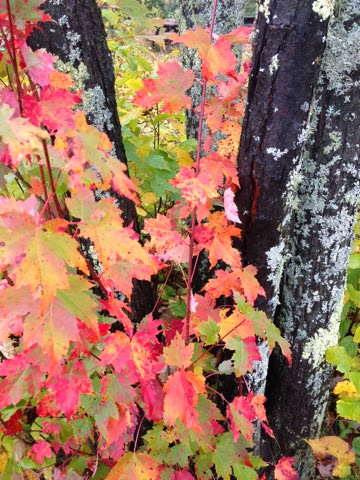
October morning collaboration between Maple, Spruce, Aspen, wicker, wind, water and Anaya Cullen


It's a crisp October morning here in Ely, MN. I'm working outside the Cedar bunkhouse at the Kawishiwi Ranger Station where the three Artists-in-Residence, are staying along with Becca Orf, Biological Plant Technician/Wilderness Ranger, a Wolf Biologist, Firefighter and the occasional surprise visitor.  This is my first time experience the full changing of the color guard in the fall and the colors are eye-popping and ever changing, and contrasting brilliantly with the dark bark of the maple wet from morning rain. I weaving wicker this morning, letting my eyes taken in the color and my mind wander into making movement phrases watching the trees moving in the breeze. The spruce is practicing stillness mostly while the apsen seems to be working on allegro steps when the breeze kicks up. The dampness has actually become a collaborator at the moment, allowing me to weave for longer before the wicker becomes brittle and needs re-soaking. There is something about getting in to a good rhythm with your hands, doing something thumb-over-thumb like weaving, that I love. It’s meditative, and often good brainstorming or daydreaming time. 


I’m reminded of a poem I have loved for years by a Palestinian American Poet, Naomi Shihab Nye called The Man Who Makes Brooms...

The Man Who Makes Brooms
Naomi Shihab Nye
So you come with these maps in your head
and I come with voices chiding me to
"speak for my people"
and we march around like guardians of memory
till we find the man on the short stool
who makes brooms.

Thumb over thumb, straw over straw,
he will not look at us.
In his stony corner there is barely room
for baskets and thread,
much less the weight of our faces
staring at him from the street.
What he has lost or not lost is his secret.

You say he is like all the men,
the man who sells pistachios,
the man who rolls the rugs.
Older now, you find holiness in anything
that continues, dream after dream.
I say he is like nobody,
the pink seam he weaves
across the flat golden face of his broom
is its own shrine, and forget about the tears.

In the village the uncles will raise their kefiyahs
from dominoes to say, no brooms in America?
And the girls who stoop to sweep the courtyard
will stop for a moment and cock their heads.
It is a little song, this thumb over thumb,
but sometimes when you wait years
for the air to break open
and sense to fall out,
it may be the only one.

Beautiful poem, I think, painting strong images with her words, subtle in moments, yet bold in thought.  It’s looking like a downpour now, time to pack up the weaving studio and head for cover. Good morning. Amazing moments and the day is still new.

Anaya

Tuesday, December 17, 2013

"Walk it Down" and Vela Magazine

by Andrea Spofford


As I'm writing an "update" post--where I've been and what I've been doing after Alaska--I wanted to take a moment and share an essay I wrote about fishing in the Kotzebue Sound. Vela Magazine (an excellent magazine that publishes "creative nonfiction inspired by travel, written by women") was gracious enough to publish my work.

If you have ten minutes take a moment to check it out.

Happy, happy travels.

Monday, December 16, 2013

Ben McCarthy//Benjamin Ceramix :: Canyons of the Ancients Artist in Residence 2013

 I wholeheartedly give thanks to everyone involved with my artist residency at the Canyons of the Ancients National Monument in Colorado, USA. The entire experience was informative, inspirational, and motivating for my artwork. During my time in the Southwest, I worked with several biologists, archaeologists and curators of the Bureau of Land Management Anasazi Heritage Center. We conducted many field observations, which entailed hiking and camping throughout the mountains and valleys of the Monument—giving the artists a clear understanding of the land once inhabited by the ancient people, known as the Ancestral Puebloans, or Anasazi.
 The landscape that was home to the Ancient Ones (Anasazi) is shaped with majestic mountains and canyons made up of astonishing geological formations. The sky constantly reveals a story of vivid color, cloud patterns, and bright stars. On a clear night, one can see far to distant galaxies—deep blue spills behind the constellations. I imagine the life of these people, building sandstone structures into the valley walls and surviving entirely from what Earth has offered them. The architecture truly commanded my attention as an artist, embracing the thought that generations of people can live off of only the earth and its resources, still while developing a strong, resilient, and creative community who have left their traces to be discovered thousands of years later. The bold, angled and curved construction of the cliff dwellings built into the canyons were designed carefully by expert masons of sandstone. Mesa Verde, as well as many other places nearby the Canyons of the Ancients, contains these archaelogical sites that unfold ancient stories through sprawling artwork carved into rock faces, artifacts, and towering pueblos balanced on islands of stone.
 The geometrically painted ceramic vessels made by the Ancestral Puebloans are another essential component to understanding their sense of creation. Not only is the precision and sense of design visually compelling, but one must also take into consideration the daily ritual crafted into the hand built pottery that was being produced by the communities. The process was utilitarian and selfless—no artist signed his or her pieces; however, their fingerprints are embedded into each coil. One can find several shards of black-on-white painted pottery in the piles of midden throughout the canyons—detritus from ancient Native American life: pieces of vessels, dippers, and sharpened arrowheads embedded into the land that have slept for over a thousand years.
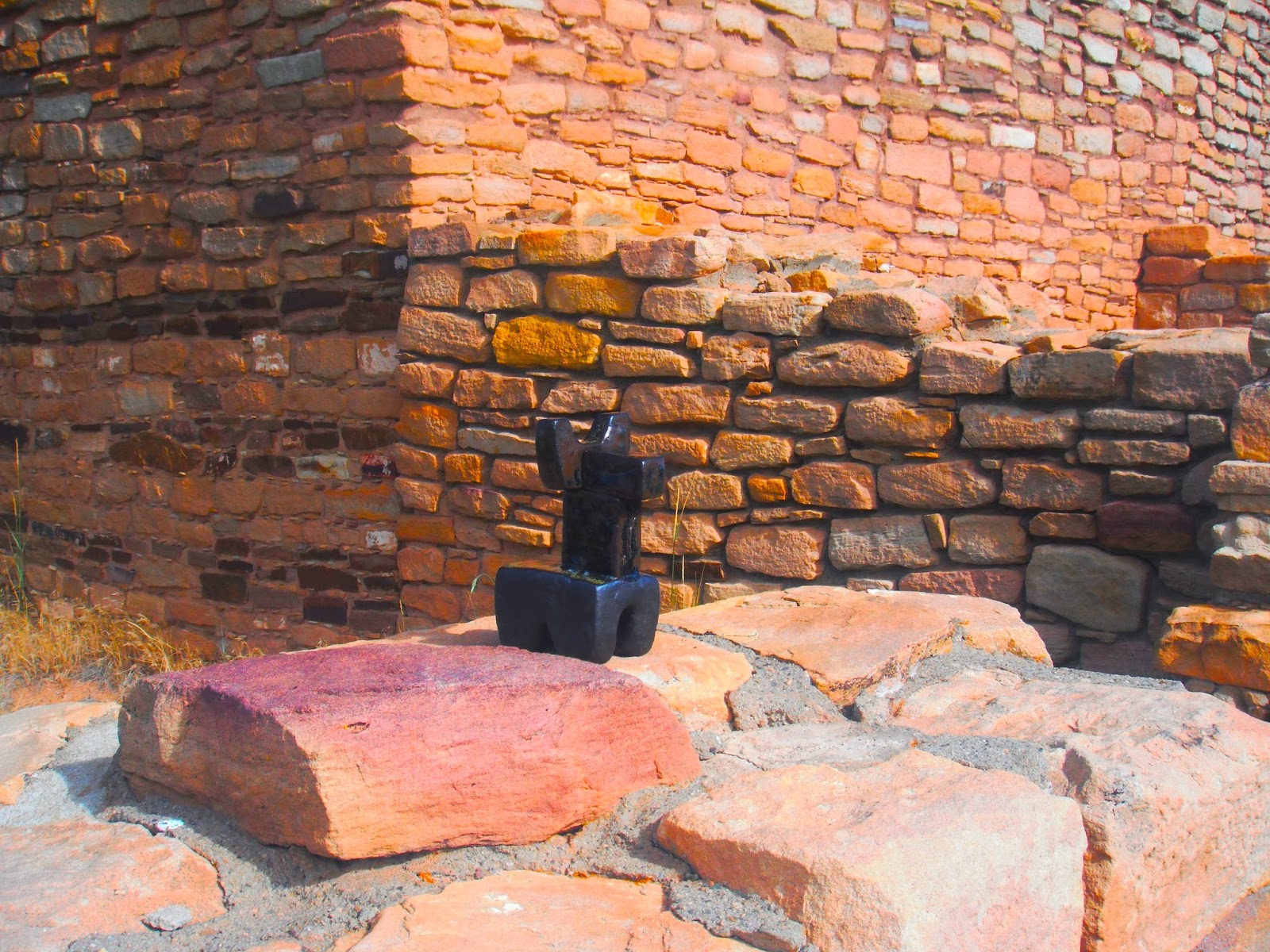
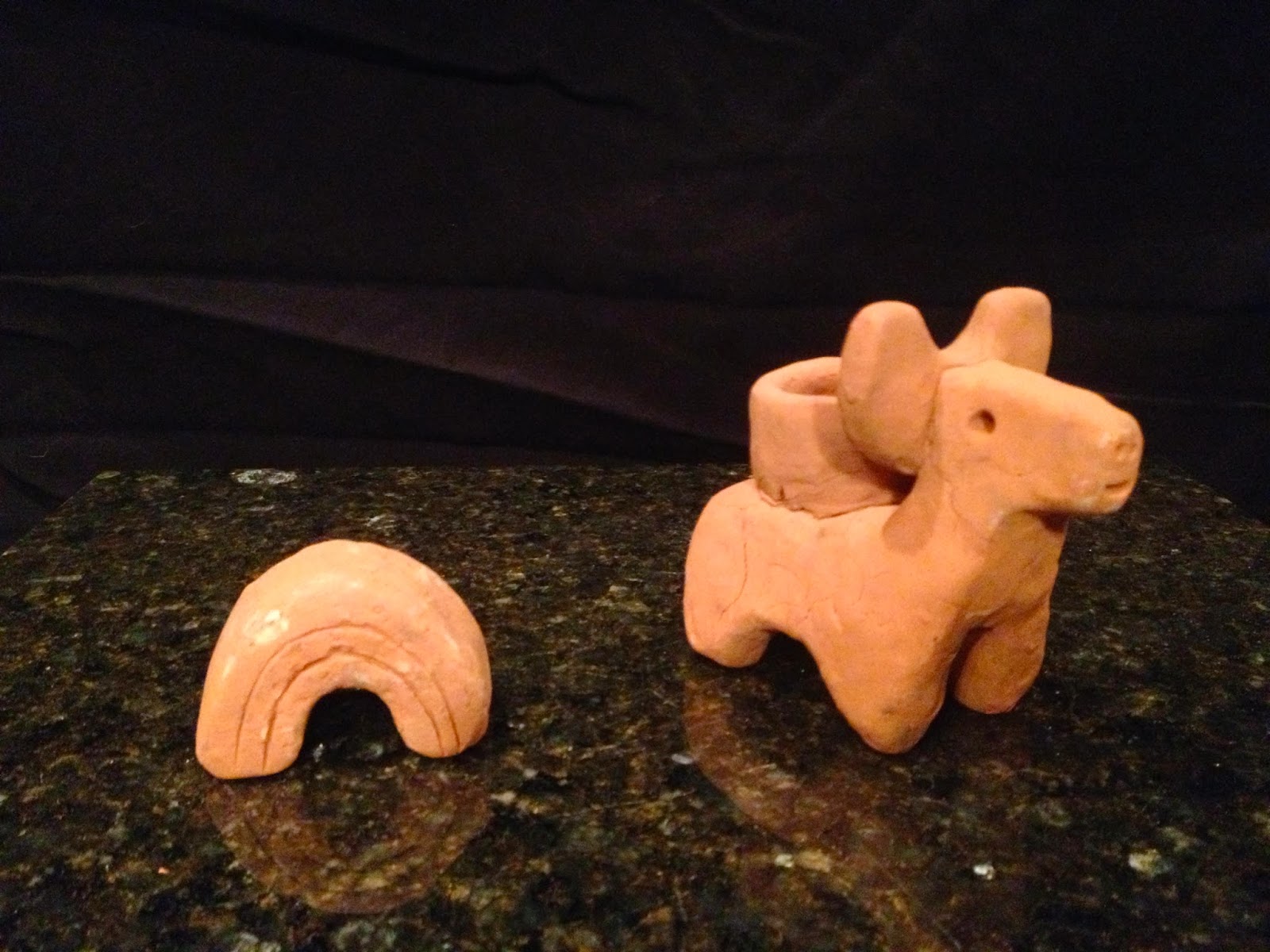
 I created several different types of artwork during my residency. I began by making a large piece with a clay I brought from Kansas City, which is called MesaMan, resembling an architectural figure influenced by Cliff Palace at Mesa Verde. When it was raw clay, it acquired the name RainChild. It has now been fired once again and treated with a chrome glaze finish, giving it the final title of PuebloPerson—a sculptural manifestation of an ancient architectural idea. After finding a source of quality clay in the McPhee Reservoir (a prominent archaeological excavation site), I decided to make a few small sculptures with the grey malleable clay from under the ground. They are simple beings—spirits and animals. The clay, once fired at a low temperature, turns to a bright, brilliant orange. If it is fired too high, it melts to a foamy, green goop. I plan attempt more, larger structures using this peculiar clay.
 With countless photographs of the places I visited, I also began to experiment with digitally altering my photos on the computer. My sculptures became able to enter the landscapes and archaeological sites of the Canyons of the Ancients, and the LED pictures started to unfold an exciting story. Using tiles of geological samples, I arranged natural colors and patterns within the rocks and skies into my own tessellations and mandalas. They are sketches and paintings using a new technique and a sense of humor to illustrate future ideas. My artwork continues to be translated into digital media, which has given insight to new possibilities of things to create.
 I was also granted the great privilege of working with Vince MacMillan, an archaeologist with the Bureau of Land Management and the Anasazi Heritage Center. He is currently working on a new method to document and archive artifacts, rock art sites, and Ancestral Puebloan towers with a process called photogrammetry. The technology includes taking hundreds of photos of an object or place from all perspectives of the piece. The photos are then entered into a computer program that renders all of the images together to create a 3D model of the artifact. Photogrammetry is being used to catalogue the museum's collection into a gallery of the art pieces and archaeological sites to be preserved and studied in the future without being affected by weather and decay. I have included a sample video, one of Lightning Tree Tower, and one of my sculptures, called the Volcano Vessel, which have been processed with photogrammetry. I believe this is a new platform for sculptural work, letting the viewer move the object as if it were weightless, zoom into high-definition detail, and experience the sculpture from all angles. Soon, the 3D model of my piece will be available in a downloadable PDF format. I plan to continue applying this technique to my artwork, and am currently incorporating photogrammetry into a computer animation that will be finished by the new year.
 Thank you for your time and the phenomenal opportunity. I hope you enjoy my latest artwork. There is already more in the making, and I will continue to post updates to the Aldo & Leonardo blog!


Ben McCarthy
(www.benjaminceramix.com)
Colorado Art Ranch
Aldo & Leopold: art + science
Artist in Residence: BLM
 Canyons of the Ancients
September 2013

Reflections on my month at CANM

Storm over Cannonball, encaustic on panel, 24" x 48"

My month was spent at Canyons of the Ancients National Monument (CANM) in far SW Colorado.  It was a month of exploring a desert wilderness filled with archeology since CANM was densely populated by the Ancestral Puebloans until  ~1270 AD when they moved south to areas with more water after a long and severe drought which was at least partially caused by human activities.  My time at CANM was marked by many unseasonable dramatic storms moving across the mesas and canyons, producing flash floods, runoff and very dramatic lightening on the heights. At the same time the Front Range of Colorado was having severe flash flooding resulting in $2 billion of damage - all likely caused by climate change.

Oncoming storm 1, encaustic monotype on kozo, ~ 18 x 24"

I came away from this trip with a heightened appreciation for the power of nature and the reach of human activity to accelerate big weather events. Being in wilderness is making oneself open to nature and also vulnerable to it in ways that in normal life we tend to assume won't happen. Climate change brings bigger more powerful weather events making us vulnerable even when we aren't backpacking in the high desert.

Oncoming storm 2, encaustic monotype on kozo, ~ 18 x 24"
This residency pushed me.  I am an experienced hiker and backpacker but had not backpacked in many years and am in my 50s.  It was physically challenging - I am in good shape but was hiking with people who are younger and fitter than I.  I drove on rougher 4WD roads than I have ever tried and realized that I was more competent than I had given myself credit for being.

Oncoming storm 3, encaustic monotype on kozo, ~ 18 x 24"
It was not a studio based residency given the amount of time we spent in the back country.  I did a lot of photography much of which I have posted previously.  Now that I am back in the studio I am painting and making monotypes - both using encaustic.  Unsurprisingly much of this work is about weather.  Hiking in high desert brings sky, horizon and weather to the forefront of one's experience.

Lowering storm 1, encaustic on cedar shake, ~7 x 10"
I am deeply grateful to Colorado Art Ranch and the Aldo Leopold Wilderness Research Institute for making this experience possible.  It was immensely rewarding and even life-changing.  Working with the wonderful staff at the Anasazi Heritage Center was a pleasure.  We were very supported by their generosity in sharing their expertise with us.

storm/ground, encaustic on panel, 6 x6"

Storm series 5 down, ink & encaustic on partially silver coated kozo, ~15 x 25"