Here is a blog which I wrote for Spectrum Creative Arts about my experience at the AldoandLeonardo residency. I wrote about the equal value of science and art. The AldoandLeonardo residency continues to float around in my psyche and make its effects even now almost 2 months since finishing... I expect those effects will continue for many years.
Blog

A Wilderness Science and Art Collaboration
Thursday, November 21, 2013

Wednesday, November 13, 2013
Interview with Elisabeth Nickles from Monomoy National Wildlife Refuge.Marine/Coastal June 17-July13, 2013
 Elisabeth Nickles is a mixed media sculptor living in Philadelphia. She has produced bodies of work in bronze, glass and paper. She attended the Boston Museum School and The Pennsylvania Academy of Fine Art and in 2007 received an MFA from Alfred University.
Elisabeth's website ~~~ http://elisabethnickles.com/
Q: Why were you interested in participating at the Monomoy National Wildlife residency?
E.N. Because I’ve always been interested in wilderness and places were the environment and landscape is not dominated by the industrial era.

Q: Why is the intersection of Art and Science so important to you and your work?
E.N. I don’t think it’s really specific to me. I think it’s the history of science that’s dominated by people. These people knew how to draw and needed artists to document their studies. These were the people who influenced actual anatomy, and somebody like Leonardo Da Vinci was very influential. He was doing dissections and discovering things with human body that no one else was doing. For me I have always been amazed with the natural world; which I don’t even like putting into those terms because we are the natural world. I especially enjoy studying artistic anatomy and discovering the comparative anatomy between myself and other species. This led me to more investigation of the anatomy of the animal world.
I really see this art science intersection as tempered, and most art is out of the landscape and born out of the landscape. It’s only recently that it isn’t, and modernism and minimalism is more based on human structures than natural structures. But before then most art was based on naturalistic ideas where artists painted landscapes, human form, animal form, and things people ate. So I guess I have always been drawn to art and the environment that surrounds us.
I think it’s really important to not ignore what’s going on in our environment, and the damage we are doing as a species. If I can enlighten or at least educate people through my work, I think that becomes important to at least have them respond to something that there not being fed through a television or computer or in social media/pop culture.
I think that artist have gotten way to egotistical; I mean I love Cézanne but he always thought the artists job is to improve on nature and I think that’s a ridiculous statement. I think that is just another arrogant statement and it’s just not really accurate, it should be – to become more like nature, become like the rhythms you perceive.
 |
| The orangish, yellowish, brownish water contrasted with the blues and light greens had me floating inside of a color field painting |
Q: What were some of your first reactions to the Monomoy National Wildlife Refuge?
E.N. Because of its location off of the coast of Cape Cod, Monomoy has been impacted by human settlement and development for hundreds of years. It is amazing how much is still present and to see the recovery in the seal populations. The exposure and harsh conditions of Monomoy kept it free of development, except for a brief time, and it has kept it wild.
There is a lot of human interference in the way the birds are studied, but I think that is necessary in the preservation of species. With that said I think the study of birds and the importance of their migratory habitats is very important for the overall diversity in the area.
There is no way anything can be totally 100% natural anymore. And by natural I mean, as it was before human population inhabited the area, especially before European settlement and commercial development.
Monomoy in itself is very stark. The colors, elements, currents, and how constant the water and wind are is pretty unique to Monomoy. I have noticed these things in various ocean environments, where you notice that the wind is shaping everything around you. Monomoy is a very exposed environment; there’s no canopy of trees for shelter and it’s all out in the open so the light is very intense. The diversity and the marine environment seem to go on forever. It becomes interesting to think about how many life forms existed before you.
Q: Did you experience any change in your perception or experience any form of enlightenment at Monomoy?
E.N. I think I did when we spent more extended periods of time on the southern end of the island. Honestly I would have stayed in a tent on a more remote part of the island, because in isolation from modern convenience, you get in a different rhythm and the simplicity is refreshing and exhilarating. Each moment in the landscape changes with weather and the course of the sun. I loved being there in the rain, seeing the storms come across the island, the colors change and the complete experience of staying in one place: looking up, down and across into each aspect of the place surrounding your body.
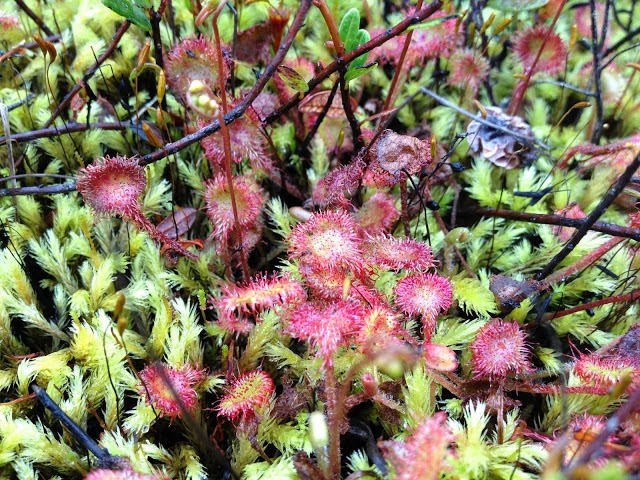
I think there is an important thing that happens when you’re not able to communicate with words. When there is no ability to talk and you just get into your own head space. I spent a lot of time on the ground, like lying down on the ground and by the bogs. I took videos and pictures of cranberries, bugs, and carnivorous plants.
 |
| sun dew carnivorous |
Q: As an artist do you feel like you influenced the scientist that you worked with?
E.N. I think that seeing the beauty and talking about it reminded the scientists who are involved in completing a specific task. Of course they see the beauty but I think it is a different way of perceiving or what we pay attention to and what we omit when we have a goal. How specialization can limit our ability to perceive the total, at least for a moment. I suppose this is the difference between a specialized biologist and an ecologist and the difference between approaching the landscape with an agenda to follow rather than a purely perceptual experience.
Regarding predator control, I have a point of view which I stated. I agree it has to be done but philosophically I had to question the practice in terms of how we prioritize our lives and the lives of other animals. What we perceive as damaging in other animal, like a coyote and a black-back gull, humans are guilty in magnitudes. Because of human development, these species thrive. They are survivors, they are cunning and resourceful. As humans, we admire this competitive edge; it is what has made our species thrive. Our adaptability and opportunism is the same, but judged quite differently. I only ask that we turn the mirror on ourselves and ask about our own impact on the world.
Q: Did you experience any absurd situations at the Monomoy Refuge?
E.N. Powder Hole is a migratory bird’s stop, and while I was there these willets would squawk at me constantly, and fly away from me. I got tired of everything being scared of me.

Also there is the motorized vs. non-motorized thing; you begin to really realize how physically lazy we have become as a species. I think people should try to use their own physical power to appreciate the motorization vs. their own physical abilities. It definitely changes your perception of scale, distance, and physical effort. It also sets us apart from the other species. Think of the Terns and the other birds flying so far with only the strength of their little bodies. It is truly amazing.
Q: What were some of the beneficial outcomes of the experience?

E.N. The relationship between artist and scientists was so enriching. Earlier in the year, I took a course through the Wagner Science Museum in Philadelphia in invertebrate anatomy and the evolutionary aspects of vertebrate development. I think the experience at Monomoy rounded my other investigations in science and sparked even more interest for me.
Also, when I came back from the residency I took my neighbors grandson to the Wissihickon park, an area of thousands of acres of protected land, within Philadelphia. The young man doesn’t get to the woods often, he is African American and the Trayvon Martin case had just been decided. Here was this young boy of eight so innocent, eager for life and knowledge . We went to the forest and walked through the creek. While we were playing in the water, a bald eagle landed above us on a branch and watched us. I thought, “how perfect, here we are- two humans in the landscape sharing the beauty, no labels and no lines, a part of nature” I believe you need to look for wilderness and the wild places where ever you are, find it and share it, it is vital, what could be more important?
 |
| Philadelphia's Wissahickon Valley is one of the popular areas of Fairmount Park. (Photo courtesy of Friends of the Wissahickon) |
Sunday, November 3, 2013
Interview with Artist: Duane McDiarmid (John Muir Wilderness~July 10-August 7, 2013)
By:Ryan Mudgett |
Duane McDiarmid studied Biology, Anthropology, Urban Studies, and Dance, prior to completing Fine Art Degrees at the Kansas City Art Institute and Florida State. He constructs sculptures, performances, and initiates social intersections in fine art venues, digital communities and in the landscape. He has fed the public ice cream from a solar work in remote deserts, bathed in used motor oil for an audience of animals in a wetland, worn a French-court inspired wig while traversing mountain passes with a Mr. Coffee pot, and dressed an Arabian horse in ‘I dream of Jeanie’ inspired garb in the Sierras. His work has been supported by the National Endowment for the Arts, the Rockefeller Foundation, and been presented at prestigious institutions including The Delaware Center for Contemporary Art, and the Santa Fe Art Institute. |
D.M.My work has long time been really interested in placing itself in more remote locations for a much more happenstance audience. There was a natural affinity with the basic mission of moving art practice out of the studio, dissemination and the strategies of museums and galleries, into something that is more akin to the natural environment. I have a love for the high altitude locations because it’s like this limitation of flora and fauna, it keeps it from being overloaded, but I don’t get access to that sort of environment. So I applied for all the different biomes for the Aldo and Leonardo, but I made the Alpine biome my first choice.
I think there is also a personal narrative prompt in there, which is that my grandparents had been trail riding on horseback into the high alpine areas of British Columbia. So I think I had a romance behind that, and I was interested in maybe repeating. At the application stage there was this question on, whether you had ridden a horse and it sounded like maybe the Alpine biome was going to involve that mode of transportation which also made it attractive. The high alpine environment is a completely different world and it has different kinds of hierarchies and I’m really interested in hierarchies. You have this wonderful scale shift between these really large scale things such as mountains and these really small scale things like the tiny little wildflowers and lichens. The middle zone of scale is what we normally deal with, houses, cars, and trees which tend to disappear out of the spectrum.
I think there is also a personal narrative prompt in there, which is that my grandparents had been trail riding on horseback into the high alpine areas of British Columbia. So I think I had a romance behind that, and I was interested in maybe repeating. At the application stage there was this question on, whether you had ridden a horse and it sounded like maybe the Alpine biome was going to involve that mode of transportation which also made it attractive. The high alpine environment is a completely different world and it has different kinds of hierarchies and I’m really interested in hierarchies. You have this wonderful scale shift between these really large scale things such as mountains and these really small scale things like the tiny little wildflowers and lichens. The middle zone of scale is what we normally deal with, houses, cars, and trees which tend to disappear out of the spectrum.
Q:Why is the intersection of Art and Science so important to you and your work?
 |
| Duane's Canister at 12,000ft.(Photo Credit: D. McDiarmid) |
Q:What are some of your first reactions to the John Muir Wilderness?
D.M.Everyone’s first reactions to the John Muir Wilderness are – are we there yet? The road in is spectacularly long for how short it is. So that becomes a really dominant first impression, it’s a time space collapse were you can drive twenty minutes to go four miles. So you start to begin to understand even before you arrive, that the usual assumptions that you’re going make to measure things are not going to work here. Time and space have a different proportionally relationship to each other.
The other thing that really stuck me, and I said it out loud even though I was alone was- “Oh my god this is what it would have been like to enter Yosemite 50-100 years ago.” There was a sense that you were in that space before it had become codified. In that, I found it immensely exciting because it was like time travel in a strange way. So that was the first impression of coming into the John Muir.
In some ways we weren't in the John Muir quite yet because then you go out to the trail head for awhile and then that’s when you actually cross the boundary into the actual wilderness. In many ways that boundary was kind of invisible. You couldn't see it or feel it quite as profoundly as the boundary between the wilderness, its surrounds, and everyday life. One of the things I found myself thinking a lot about was whether or not there should be a discernible shift when you cross these specific boundaries. I found myself leaning towards the side of whether there should be a distinct shift when you cross a boundary into something that’s actually designated as wilderness. In terms of how we think about trail maintenance, and how we think about all these things. There are some real differences in terms of how you maintain the trails - hand tools vs. power tools, wheelbarrows yes vs. wheelbarrows no. But there’s a culture of what is a well maintained trail, and what are the measures that we are heading for, which seems to cross that boundary with utter oblivion to it, and that was something that I found myself pondering quite a lot out there.
In some ways we weren't in the John Muir quite yet because then you go out to the trail head for awhile and then that’s when you actually cross the boundary into the actual wilderness. In many ways that boundary was kind of invisible. You couldn't see it or feel it quite as profoundly as the boundary between the wilderness, its surrounds, and everyday life. One of the things I found myself thinking a lot about was whether or not there should be a discernible shift when you cross these specific boundaries. I found myself leaning towards the side of whether there should be a distinct shift when you cross a boundary into something that’s actually designated as wilderness. In terms of how we think about trail maintenance, and how we think about all these things. There are some real differences in terms of how you maintain the trails - hand tools vs. power tools, wheelbarrows yes vs. wheelbarrows no. But there’s a culture of what is a well maintained trail, and what are the measures that we are heading for, which seems to cross that boundary with utter oblivion to it, and that was something that I found myself pondering quite a lot out there.
Q: What do you believe to be a highlight to your time spent in the John Muir Wilderness?
D.M.I did two eight day tours walking in the John Muir with Wilderness Rangers. As fellas in the program we were sent on an eight day journey. I decided during that journey and the couple of days following as I was developing what my artistic response was going to be to that initial experience. I wanted to express that response actually on the trail in the John Muir, as opposed to off the trail about the John Muir Trail. So I decided to go on a second tour as an artist opposed to as artist/researcher. My fellow artist Tory did eight days on the trail and I ended up doing sixteen because it became really important to my work. It also profoundly changed the way I perceive the whole thing, and what my discourse around the John Muir would be long term. On my second tour I had prepared all of these props, discourses and these performative acts based on my first tour. On my first tour we were primarily on the John Muir and the Pacific Crest, which are pretty heavily trafficked by hikers. There was a great sense both for Tory and I, which we discussed a lot; we both were stuck by this Disney esc. quality of wilderness on our first tour. Not that we weren't having other experiences that were truly profound and that it wasn't incredibly beautiful in terms of landscape. We really noticed that there was a lot of performing going on in the wilderness. In terms of performing how great a hiker you are, and performing how many miles you had come, performing the sustainability of your fashion choices, and performing the duties so that it would appear no one had ever been here even though twenty people are passing there every day.
My work that I developed to go about on my second tour was really predicated on the premise of it being about that phenomenon and for that level of traffic. But on the second tour we went to a very different kind of place. I found myself having much more of the experience that I had hoped for. My work was designed and propped out and loaded onto my pack with the idea of doing these slightly tongue n’ cheek, critical little glib performances. But on my second tour it wasn't really what I encountered, so it’s not what I ended up really doing. I ended up going off trail quite a lot and even when we were on trail we were not on the major trails we were on secondary trails.
 I ended up having this quasi-transcendental experience of hiking and following my shoes higher and higher in elevation to lake and snow field, and over talus. That made me really, get beyond the performing, to the point where - I’m in the wilderness, and actually crossing over to being in the wilderness. Because I made this shift, the art had to change from being discursive about wilderness between people pretending to be in wilderness in different ways and had to shift. It had to shift to,what are the acts that I can make as an artist in the wilderness that don’t pop me out of it, but rather keep me in it? That was a very different question. This led to another whole set of performative gestures that I really ended up considering as the real work of the residency. It had to do with figuring out how to mark and acknowledge presence while leaving no mark of my presence, which is a very strange way for a sculpture to try and work. Most of what we do is material and it’s in some way or another is about shifting material into a new configuration. So it became very interesting for me when I was in a world where my goal was not make any material shifts.
 I brought along a couple bear canisters that I decked out as circus props with the idea that even though wild bears were performing a entertainment value to human concerns of wilderness. I was adding this level of adventure and risk that wasn't really real. I did this by perverting the bears foraging behaviors in a way that was responsive to the non-wilderness world, as opposed to the response to the wilderness world. That was central to my original thesis going back in. It was, nothing was operating in response to the wilderness, everything was operating and responding the non-wilderness, and I was going to try and shine a light on that. To that end I had these bear cans with me that were decked out in this circus costume and they had musical instruments in them. The idea being, when the bear came to raid our food they would end up performing a chaotic Dadaist music for us which is a complete perversion of wild bear behavior. That was a potential that I ended up creating, a ritual were I would set these things out with the hope that nothing would happen, and that’s what did happen, the bears never came. They never reduced themselves to that level of clownery.
But then I also used these devises as sort of a worry stone. When I would walk I would swing this bear can with this wind chime in it and it would be responding both to its contained internal space and to the variations of me going over a terrain. The rhythm of that swing having to be a bodily extension of my body moving through this landscape, and it was performative but it was not for anything or anyone. It was just itself, in its own moment. That became the nexus of the way I thought about my actions up there. The way to be an artist in the wilderness is for the art to exist like other wilderness elements, which is without self consciousness to external viewership. That was the profundity of it.
Then of course there is the re-entry of it, you come back out of the wilderness and you have a contractual obligation to show something, so you have to negotiate all those spaces. On one hand there was a compromised aspect to it, in that I did record documentary photographs and now I’m processing them for consumption in the non-wilderness world. They really are secondary acts to things that occurred between me and the landscape in the landscape that were about that time and that place and that moment, and nothing and no one else.
Q: As an artist do you feel like you influenced the Forest Service Rangers that you worked with?
 D.M.The Forest Service Rangers that I worked with were largely involved with janitorial services, trail management, more labor and less esoteric science. I think that if I left longing for anything that didn't occur it would be that much more intimate overlaying of the scientific research with my own personal artistic research and how those things would mesh. That said, as the big picture-I do think that our presence both Tory and mine on the first tour, and mine on the second influenced the Rangers. I think we did this by presenting two ways of seeing and ways of questioning what they were doing. We also discussed what those things meant emblematically, and how what they meant emblematically may even conflict with what they thought they were doing. In that sense, I think there was a level of expansion of perspective that was exchanged back and forth, where the artists were actually able to contribute some insights. I say that because I believe I experienced it in the moment when it was happening and there was feedback when we were socializing with the Rangers back down off the mountain that seemed to confirm that.
Our insights may have even been problematizing to the Rangers normal tasks. When you start to discuses in depth which Tory and I did around the stove at night cooking, that your perceiving there task of firing eliminations of a theater that’s about preparing the set for the next but same play. Preparing for the next person to pretend that they are arriving at this river bank, and no one else had ever slept there before- and that is all bogus.
We have a very thin veneer, and there keeping that thin veneer going. I think that really made them ask some new questions about what their role was as a Wilderness Ranger and where is the center of gravity of this supposed to reside. I’m not sure that we did a lot of good from the Forest Service’s point of view. From the idea of human beings being aware and questioning, or investigating their own behaviors and how that relates to wilderness. I think the art perspective certainly opened up some new vantage points.
It’s very easy to say, or to look at, the action of picking tiny pieces of foil out of some dirty campers, meaning all campers fire rings, because we never came across a fire ring that didn't have little bits of foil in it. To understand that as-I’m out here protecting the wilderness from this foil, that’s what I’m doing, can open up some new questions. Our perspective really became a questioning of that because essentially what you’re doing is your mitigating the consequences of human interface to such a degree that the people are not confronting it and on top of it there not having the experience they think they’re having because you’re intervening in this un-natural way. What is the wilderness of that? I’m not sure if it’s a question that anyone but an artist would ask? It’s about the non-tangible events of the task rather than the tangible parts.
Q:Did you experience any absurd situations in the John Muir Wilderness?
D.M.I think the whole way Wilderness Ranger work is measured is utterly absurd, completely absurd. Because what these guys and gals had to do at the end of every day; was they had to sit down and make a list, because they had to report it back to their supervisor to prove that they were doing a good job. More or less they have to say like-How many visitors did we talk to? And okay that one is maybe fine. Except for it’s predicated on the notion that you’re serving human beings, which the Wilderness Act is really not predicated on. The Wilderness Act is predicated on the notion that you’re protecting wilderness. So even in that one, that seems so logical, you’re starting to see that the more visitors you have the more visitor contacts you have the better job your doing as a Wilderness Ranger. You’re starting to erode the main mission by the reward structure that has been set up by the employer employee relationship. Then you start extending that to things like- How many trail gutters did you clear? How many windfalls more than 4 in. diameter trees did you cut? How many illegal fire rings did you eliminate? How many legal fire rings did you clean? It’s all really about motel maintenance and interesting enough, what do these guys and gals do on their days off? They go hiking in the wilderness because there not hiking in the wilderness when they are being Wilderness Rangers. When I wanted to know something about the wilderness, about the land, about the flora, about the fauna, about the geology it was all stuff that they garnered on their days off, not doing their job as Wilderness Rangers. As Wilderness Rangers their job is not to range, it’s to clean. It really struck me, and in talking to the director of the John Muir Wilderness, Adam Barnett reaffirmed that. He said casually on a hike that we took together one day, that he felt that the number one job of a ranger is to observe, because if your fixated on doing too many miles then you’re not observing. Just observing is the most important job of a ranger. I think he absolutely meant it, and he absolutely implements it in the way he practices and I admire him immensely for that. Somehow the structure of how the lower ranking Rangers are managed two or three layers beneath his insights, are not supporting that. Nowhere on the list did it say- How much time did you spend observing the wilderness?
I thought about this a lot when I got back, the whole title of Ranger implies if you forget what it means literally in vernacular use, you think about what does it mean much more poetically? It’s about wandering the range. It’s another word for wanderer. Then you add this definition of Wilderness Ranger, which seems like it should confront that more firmly, and yet the wilderness rangers I talked to said they rarely get more than 100ft. away from a trail. There not ranging. So did I find an absurdity out there? Yeah. We don’t know how to pay people to be Wilderness Rangers, we only know how to pay them to be motel maids. That to me is utterly absurd, because cleaning up someone’s campsite is far less important than really protecting, understanding, wandering, and guarding the safe and beautiful, not just safe for humans but safe for the wilderness, its being a protector of the wilderness. I think everyone understands on some level that is the primary mission of their job, but the accounting for it has completely obscured that. Accounting obscures real mission.
 |
| Photo Credit: D. McDiarmid |
Saturday, November 2, 2013
News from the Field

Jeff Lee, Plant Ecologist / Botanist with the Minnesota Biological Survey, just posted his account of the Boundary Waters Aldo Leonardo trip on the Minnesota Biological Survey's blog. Here is a link to it: www.dnr.state.mn.us/eco/mcbs/news2013.html (with photos). Here is a reposting of the article:
"A unique opportunity arose when the Minnesota Biological Survey (MBS) was invited to participate in the Aldo & Leonardo Wilderness Science and Art Collaboration. A partnership of the Colorado Art Ranch and the U.S. Forest Service Aldo Leopold Wilderness Research Institute, the collaboration aims to bring together visiting artists and resident scientists to (1) highlight the success of the Wilderness Act on its 50th anniversary in 2014, (2) honor the work of wilderness scientists, and (3) capture and communicate the value of wild areas through artistic expression and interpretation.
As part of the collaboration, MBS plant ecologists Lawson Gerdes and Daniel Wovcha, energetic volunteer Jenna Pollard and I teamed up with visual and relationally-based artist Katherine Ball for an eight-day, MBS Border Lakes survey trip in the Boundary Waters Canoe Area Wilderness. During her residency, Katie has become familiar with MBS field surveys and mission to guide land management decisions by providing high-quality data on the distribution of rare plants, animals, and communities. Equally poignant, however, was the influence that Katie had on us. Seeing her marvel at the beauty of the Border Lakes, and express that awe with daily postcard writings and reflection, affirmed that wilderness conservation is a shared commonality among scientists and artists alike.
Our route took us through Lakes One, Two, Three, Four, Hudson, Insula, Kiana, and Alice. September weather in the Boundary Waters can be unpredictable, but after two days of rain at the beginning, we were left with dry conditions, cool mornings, and three sunny 73° days at the tail end. Each morning, we left our campsite on the northeastern side of Insula Lake and paddled to the day's field site. Relevé vegetation plots in a red pine forest (FDn43a) and jack pine woodland (native plant community determination uncertain) on Kiana and Alice Lakes respectively, were punctuated by rare plant searches and native plant community evaluations. New populations of American shore-plantain (Littorella americana, State Special Concern) were discovered on pebbly shores of small islands. Franklin's Phacelia (Phacelia franklinii, State Threatened) was found for the first time in the Lake-North sub-county and in the area affected by the Pagami Creek wildfire of 2011. This species is known to prefer habitats of recent disturbance at a fine scale (e.g. tree tip-ups). Until now, however, it had not yet been documented from such an intense, broad-scale disturbance as the Pagami Creek fire in Minnesota.
The fresh perspective that Katie brought to a MBS Border Lakes survey trip was invaluable. Parallels between scientists and artists become apparent as both professions gain greater familiarity with one another. For instance, carrying out a relevé vegetation plot demonstrates precision and detail that is needed for the plot to accurately describe the greater native plant community. The same precision and detail is equally vital for artwork to successfully convey a message, render emotion, or catalyze social change. Our partnership with Katie does not end with the conclusion of the trip. The collaboration extends to her creation of an art piece that celebrates wilderness and by association the biodiversity contained within. This work will become public and showcase how science and art together is more powerful than either one in isolation." — Jeff Lee, 2013
Thursday, October 31, 2013
Benjamin Ceramix: Clay From The Mountains (Canyons of the Ancients National Monument)
While working as an Artist in Residence at the Canyons of the Ancients, I often make trips to the McPhee Reservoir, a beautiful winding road that unveils clearings of snowy mountain ranges, several giant snakes of water, and green fields spotted with shadows of passing clouds. The site is characterized as the largest and most funded archaeological excavation site in the country's history. Hundreds of artifacts such as patterned pottery, yucca sandals, and effigies made by the Anasazi were found there and catalogued for the cultural preservation of our ancestors.
One day I decided to venture into the shallow valleys of the reservoir a day after rain. I came across the remains of a stream, which sat like a silent mud road assembled with geometric, tightly-fit earth blocks. The tessellation of mud formations seemed to resemble the keyboard of a computer and sank with gravity as the trodden path of my feet created a sculptural novel.
I lifted a dried panel the size of a laptop of mud to reveal a bottomless cauldron of clay—dark grey with tan fine grain grog, sticky, malleable, and cold. After shoveling a mass of substance from the ground with my hands into a large Ziploc bag, I walked back to my truck with the bag of clay on my head. I combined this clay with dry elements from other areas of the land (dried mud, sandstone, fine gravel, some bugs), collected near areas of sacred views and holy ancestral places. From this unique mix manifested several small, intuitive sculptural beings. The photos are below, and the pieces will be getting fired in a local artist's kiln this weekend (updates to come).
The large piece is named RainChild until it emerges from the kiln, and will then maybe be given a new name. It is about 60 lbs, 2', and is made with a Cassius Basaltic clay that will fire to a dark brown or black. I made it during the first week of my residency after absorbing the ancient architectural beauty of Mesa Verde. It resembles the cultural spirit of the pueblo community long ago—the head and face reminiscent of a sandstone tower built into the cliffs.
I plan to make several more pieces from the clay found in this area while I am here. At the moment, I am also creating an animation of my sculptures that features a digital technology project that was made via collaboration with Vince MacMillan, an excellent archaeologist of the Anasazi Heritage Center and BLM. I expect it to be done soon and am excited to share it with you all!!
Cheers,
Ben


Sunday, October 27, 2013
Installation: Contemporary Land Surveying and Scientific Research in the Wilderness

At the end of my Aldo and Leonardo Residency in the Boundary Waters Wilderness, I collaborated with scientists from the Minnesota Biological Survey Lawson Gerdes, Jeff Lee,Dan Wovcha and field assistant Jenna Pollard, to make an installation that rendered a scene of what 21st century land surveying entails — and what one variety of scientific research in the Boundary Waters wilderness looks like: the relevé method. The installation contains scientific tools, information, camp gear and idiosyncratic objects that illustrate the character of the four of us that went to the Boundary Waters to survey the biodiversity of the area using the "relevé" method. Using aerial infrared maps, we canoed and bushwacked to specific sections of the Boundary Waters to mark off 20x20 meter plots and assess all the plant species living in each plot. We surveyed each relevé plot at multiple levels, from the canopy to the ground cover, assessing density and maturity. We would also dig a hole in the ground to inspect the soil layers (if charcoal was present that would indicate there had been a fire) and test the PH of the soil. By performing the relevé method, we were able to generate a scientific rendering of the native plant community and fill in the map of biodiversity for the state of Minnesota that the Minnesota Biological Survey has been charting over the last two decades. The installation was created at Wolf Ridge Environmental Learning Center in Finland, MN.
The five of us have discussed exhibiting this installation again some day at a larger public institution. We have ideas for a series of public programs that could go along with it, including relevé school curriculum, the launch of a relevé society (these societies/clubs are prevalent in Europe), relevé events/performances, and workshops (for example: where participants can learn how to press plants, make a plant pressing book, and a solar plant dryer). We have plans to make a proposal to the Minnesota Science Museum and the Bell Museum of Natural History or during the 50th Anniversary Celebration of the Wilderness Act in Albuquerque. If you have any suggestions for any institutions to contact about hosting the exhibit, please email kb@katherineball.com.
Photos courtesy of Jenna Pollard, Dan Wovcha, and Katherine Ball.
Much gratitude to Wolf Ridge for hosting the installation, Lawson Gerdes for bottomlining the science end of the collaboration, Jeff Lee for leading the Boundary Waters Trip, Dan Wovcha and Jenna Pollard for their filming/photography, zest for life, insatiable curiosity, deep wonder and reverence for the flora and fauna with which we share this planet.


Saturday, October 26, 2013
Canyons of the Ancients National Monument 2013 Artist in Residence: Ben McCarthy//Benjamin Ceramix
Hello all!
I have been enjoying all of your updates and glimpses into the different biomes/residencies that Aldo & Leonardo have organized and what has come of it—looking forward to how it evolves. What a phenomenal opportunity!! I am truly thankful and honored to be a part of this project. My artist residency ended the final day of September, and I am still happily living and working in the area to where I was transferred. I plan to continue my creative study of this beautiful, hidden area that is home to the largest and most abundant archaeological site in the country. The experience of shadowing and camping with the other artists, biologists and archaeologists of the Anasazi Heritage Center and the Bureau of Land Management was unique, informative, inspiring, and motivating. It is as if to have been let in on an ancient secret that I will ponder for the rest of my life—given the gift of an eternal creative fuel, which I have continuously found within nature, the lives and artwork of ancient people, and modern-day habitation of the planet. The project's emphasis on working with the organizations that maintain the land today sparked ideas of the history of humans in wilderness, our mark, the current state of how nature is governed, and an urgency for conserving its ecosystem, culture, art, and resources.
Days of hiking through vibrant olfactory foliage (especially green due to monsoon season) of sage and juniper, standing next to sandstone and mud-masoned giant towers constructed by ancient human beings known as The Ancient Ones (or Anasazi), approaching a clearing to find a massive faceted triangle of carved stone with archaic doodles melted through the purple desert rock varnish to reveal glowing orange petroglyph stick figure gatherings amidst floating spiral symbols (that may actually resemble ancient semiotics for water). Migrating black and orange tarantulas crossing the road, each traversing its own journey to somewhere, silent geological patterns stacked to create a castle disguised as a cliff, from where points of erosion within the wind-sculpted stone walls emerge natural statues of heads and faces that speak with the skies and think for centuries. Then there are places where one can see where, long ago, Mother Earth opened her arms to the Ancestral Puebloans and gave them cathedral-like caves in the mountain canyons on either side of the valleys of Mesa Verde. The ancient people cooperated with the earth, survived off of its growth, and built small cities inside the cliffs. To see such natural, complex, ancient structures is simply phenomenal, and the view provides an Escher-style visual puzzle majestically camouflaged into Nature. I sat across from it for hours, deep in thought and admiration, while carving a chunk of red and orange sandstone into a 3-dimensional hieroglyph with a piece of obsidian I found near Yellowstone.
The artistic process of analyzing, distilling, and creatively articulating the substance absorbed from the Canyons of the Ancients takes time and an open mind, and I am only beginning to translate the miles of geological formations, ghostly cliff dwellings, and ancient geometric pottery patterns into pieces of my own artwork—sculptures, pictures, and poems that resemble my intuitive, cognitive response. I found myself particularly inspired by the surreal scenes and creatures within rock art, and the "T shaped" doorways/windows found often in Ancestral Puebloan architecture.
In addition to creating a number of sculptures from clay that I dug from the mountains (which are currently drying and will be fired soon! {updates to come}), I began to decode the things I was seeing each day through the countless digital photographs I took during our exploration of Wilderness. One thousand, high definition photos of a landscape still cannot begin to explain the sense one gets when entering the labyrinth of Nature. In an effort to encapsulate the time, spirit, and language of the Canyons of the Ancients, I developed many new techniques: one called geokaleidoscopics, with which I transform my photography into fractal mosaics that unfold into intricate meta-textured beings of nature and ancient architecture. Colorful visual patterns form from simple pieces of sky, plants, or rocks. The sculptural images provide a snapshot of an interactive story (enhanced by the "zoom" feature) with an intergalactic quality, while still giving the viewer a perspective of the terrain, colors, sites, and artifacts of the place. I have also included a photo of the completed Anubynx sculpture that I made before the residency, which I posted a photo of pre-fire a while ago. The Anubynx and several other of my handmade, large-scale clay sculptures experienced a material metamorphosis and teleported into a tour of the digital landscapes depicted within my pictures you'll see below. They had a blast and will definitely visit again!
A big, glowing "THANK YOU" to Grant and Peggy at the Colorado Art Ranch for all of your kindness and support, to everyone at the Anasazi Heritage Center and BLM for your welcoming hospitality, interest and great conversation, and to everyone involved with the Aldo & Leonardo Art + Science Collaboration who is contributing to make this something great!!
-Ben


Subscribe to:
Posts (Atom)